

EcoNavis Selected to Lead U.s Study on Integrated Propulsion Optimisation


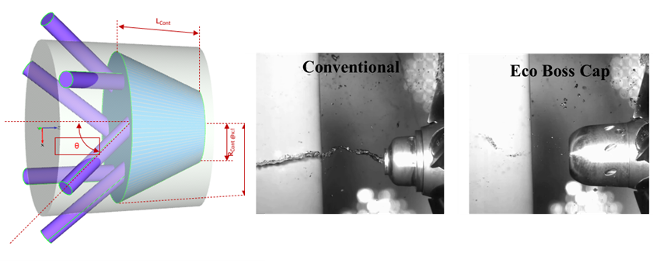
 The Eco Boss Cap (EBC). © EcoNavis Solutions
 Oscar Propulsions' PressurePores technology. © EcoNavis Solutions

EcoNavis Solutions has been selected by a US Federal Government agency to lead a project aimed at demonstrating how integrated hydrodynamic optimization can reduce fuel consumption and underwater radiated noise in offshore vessels and workboats operating in the Gulf of Mexico.
The award, valued at $500,000, will support a full-scale retrofit and validation program on a designated workboat, with the objective of establishing a repeatable framework for improving propulsion efficiency while addressing increasing scrutiny around underwater radiated noise. Rather than assessing individual technologies in isolation, the project will evaluate the combined impact of multiple energy-saving devices applied as an integrated system.
The approach reflects a broader shift within the industry towards whole-vessel performance, particularly as operators face more stringent emissions and environmental rules along with rising fuel costs.
The technical scope centers on the integration of a new flow-aligned twisted rudder, dubbed EcoVane, EcoNavis’ proprietary propeller hub Eco Boss Cap, and pressure-relieving modifications to the propeller blades. Each element targets a different source of hydrodynamic loss, from wake misalignment and drag at the rudder to vortex formation and cavitation at the propeller hub and blades.
The figures will be validated through controlled before-and-after sea trials, including direct measurement of shaft power and acoustic output.
The work will begin with computational modeling to establish a performance baseline for the selected vessel, followed by iterative design optimization using vessel-specific flow analysis.
Manufacturing, installation and full-scale trials will then be carried out, with all performance data collected and verified using recognized international standards, including ISO 15016 for fuel efficiency and ISO 17208-1 for underwater noise measurement.
EcoNavis will lead the hydrodynamic design and simulation work, supported by a consortium of propulsion specialists that include King Propulsion, CJR Propulsion and Oscar Propulsion.
The project will also draw on established class approval and manufacturing processes to ensure that the solutions are scalable and suitable for wider fleet adoption.
Beyond the demonstration vessel, the program aims to generate a validated dataset that can support wider deployment across similar vessel classes.


