

Nuclear Power Considered for Transatlantic Container Route

Lloyd’s Register, A.P. Moller - Maersk (Maersk) and the ports of Charleston and Felixstowe will examine the security and safeguarding requirements for the theoretical deployment of a nuclear-powered container ship route between the UK and US.Centered on a conceptual nuclear-powered container ship, the Pink Corridor will examine the requirements for theoretical port access on the specified route. Key areas of focus will include ship security, safeguards, cyber resilience, emergency response…
MarAd Inks Pact to Move on Maritime Nuclear Power

The U.S. Department of Transportation's Maritime Administration (MARAD) and CORE POWER (US) Inc. signed an agreement to accelerate the commercial, industrial, and regulatory pathways for U.S.-flagged nuclear-powered commercial ships. Fueled by small modular reactor (SMR) technology, this first-of-its-kind partnership will advance the President Trump's agenda to strengthen American shipping and secure energy dominance."President Trump has made it clear that American energy dominance and maritime strength go hand in hand," said Maritime Administrator Stephen M. Carmel.
Deployable Energy and Hornbeck Offshore Partner to Advance Nuclear Power

Deployable Energy has signed a Memorandum of Understanding with Hornbeck Offshore to transform five strategic maritime and offshore markets through the utilization of Deployable Energy's Unity Nuclear Battery. Hornbeck Offshore has also made a strategic investment in Deployable Energy.The collaboration will combine Deployable Energy's transportable microreactor technology with Hornbeck Offshore's marine operating fleet expertise to develop maritime nuclear applications in inland waterways…
How the U.S. Coast Guard is Shaping the Future of Maritime Nuclear Power

Looking back at history one could argue that it was French author Jules Verne in his book “20,000 Leagues Under the Sea”, published in 1869, who was speculating about a new power source much in the same out of the box thinking that H.G. Wells employed when he wrote about inter-planetary flight in “War of the World’s. Verne was writing about “electricity” from batteries using seawater which he created after studying the model of the newly developed French Navy submarine “Plongeur” at the Exposition of 1867.In the novel…
Op-Ed: Bringing Nuclear Propulsion to Commercial Reality

With demonstration projects now underway, including a nuclear-powered LNG tanker and an offshore vessel, the debate is shifting from whether nuclear shipping is possible to how it can be delivered. Jan Emblemsvåg, Professor at the Norwegian University of Science & Technology (NTNU)'s Department of Ocean Operations and Civil Engineering in Ålesund, argues that the key barriers are no longer technical, but regulatory, commercial and political.Nuclear propulsion is returning to the…
Nuclear Power for Commercial Vessels Central to ABS, HD Hyundai JDP

ABS, HD Korea Shipbuilding & Offshore Engineering (HD KSOE) and HD Hyundai Samho Heavy Industries (HD HSHI) signed a joint development project (JDP) for the “Conceptual Design of a Nuclear-Powered Electric Propulsion System.”Under the agreement, HD KSOE and HD HSHI will develop the basic design, electrical component specifications and arrangement plans for a nuclear-powered electric propulsion system tailored for container ships. The agreement forms a framework to assess the technical…
Nuclear-Powered DP Vessels Technically Feasible, Vard Study Shows

A study led by Vard, a subsidiary of Italy’s Fincantieri, has found that nuclear-powered offshore vessels are technically feasible, confirming that small fourth-generation nuclear reactors can be integrated into dynamically positioned vessels while meeting safety, redundancy and operational requirements.Results from the NuProShip II research and innovation project show that nuclear propulsion can support DP2 power architectures, with potential adaptability to DP3 standards, offering…
ABS and KRISO Partner on Small Modular Nuclear Reactors
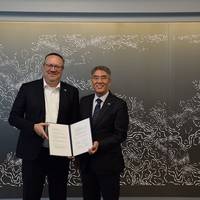
ABS and the Korea Research Institute of Ships & Ocean Engineering (KRISO) signed a memorandum of understanding (MOU) to cooperate on the application of small modular reactors (SMRs) in the marine and offshore sectors.The agreement establishes a framework for both organizations to exchange information and engage in joint research projects related to concept designs for an SMR-powered ship and a floating SMR power generation platform. Among the objectives are identifying and developing applicable regulatory guidelines and international standards.“Nuclear energy offers unmatched energy density…
Safeguarding Security on Nuclear-Powered Ships

No civilian maritime nuclear facilities have been commissioned in over four decades, but there’s been three major reports released this month on their future potential.DNV’s latest report, Maritime nuclear propulsion: Technologies, commercial viability, and regulatory challenges for nuclear-powered vessels, provides a regulatory perspective on security, one of the key challenges for future adoption. As it says: Safety, security and non-proliferation remain paramount. Future installations must be designed to withstand collisions, groundings, and external threats such as sabotage or piracy.
MIT Maritime Consortium Releases Nuclear Ship Safety Handbook
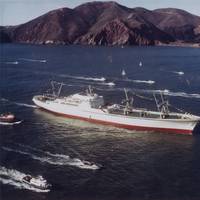
A new “Nuclear Ship Safety Handbook” by the MIT Maritime Consortium aims to set the standard for safe maritime nuclear propulsion.Using research data and standards, combined with operational experiences during civilian maritime nuclear operations, the handbook provides unique insights into potential issues and resolutions in the design efficacy of maritime nuclear operations, a topic of growing importance on the national and international stage.The handbook, which is divided into…
HD KSOE Gets DNV’s Blessing for Nuclear-Powered Container Ship Design
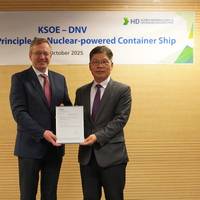
Classification society DNV has awarded HD Korea Shipbuilding & Offshore Engineering (HD KSOE) an Approval in Principle (AiP) for a new 15,000 TEU container vessel design powered by Small Modular Reactor (SMR) technology.The design demonstrates the application of SMR technology in a 15,000 TEU container vessel, capable of operating at 24 knots.The vessel concept incorporates a supercritical CO2-based power generation system, which can provide higher thermal efficiency and a reduced…
Nuclear-Powered Ships on Distant Course to Net-Zero Horizon, DNV Finds
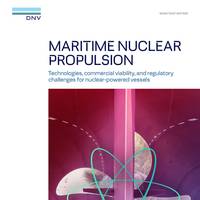
Growing environmental pressures are reviving interest in nuclear propulsion as a potential long-term route to decarbonize shipping, DNV said in a new paper, despite there being no civilian nuclear-powered vessels built for more than four decades.DNV’s latest report, Maritime nuclear propulsion: Technologies, commercial viability, and regulatory challenges for nuclear-powered vessels, highlights how maritime nuclear technologies differ from land-based reactors, and emphasizes the need to address technological…
Navigating Nuclear Energy in Maritime with Lloyd’s Register at Helm
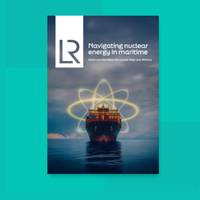
Lloyd’s Register (LR) has published a new guidance document, providing the first roadmap for the safe and responsible use of nuclear technology in commercial shipping and offshore industries.As the maritime sector accelerates its transition towards sustainable energy solutions, nuclear power has re-emerged as a viable solution to achieve net-zero ambitions. The guidance, Navigating Nuclear Energy in Maritime, was developed in partnership with Global Nuclear Security Partners (GNSP) and marine insurer NorthStandard.It sets out the practical steps project teams must take…
Rolls-Royce Signs Skills Agreements in Support of AUKUS

Rolls-Royce has signed memorandums of understanding (MOUs) with both Western and South Australian governments that outline a commitment to collaborate on workforce development, skills training, and critical technologies to support the growing defence sectors in each state.This marks a significant step forward in Australian preparations for the AUKUS submarine program which will provide the nation with their first conventionally armed nuclear navy.Under the agreements, both governments…
ABB, Blykalla Join Forces for Nuclear Power Tech for Maritime Industry
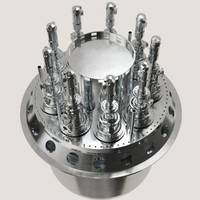
ABB has signed a memorandum of understanding (MoU) with Swedish nuclear energy company Blykalla to support and accelerate the deployment of small modular lead-cooled reactors to the maritime industry.Building on the terms of an existing MoU between Blykalla and ABB signed in October 2024, which targets developing lead-cooled SMR technology to support Sweden’s clean energy requirements, the agreement expands the partnership and aligns with growing momentum for nuclear energy as a marine power source.Blykalla’s Swedish Advanced Lead Reactor (SEALER) is a highly compact…
Op/Ed: Public Opinion on Nuclear Power has Deep Roots

Australia does not have nuclear power stations, and it does not have nuclear weapons.I remember having lessons and debates on it in high school, many years ago. My favorite science teacher was dead against either use of nuclear technology.One of the most interesting arguments I remember hearing was that the technology developments that make nuclear power more efficient would also help make nuclear bombs more efficient.Fiji is much the same as Australia, and it has even ratified the Treaty on the Prohibition of Nuclear Weapons…
LNG Carrier with Nuclear Propulsion Offers Faster Zero-Emission Transits, ABS Finds
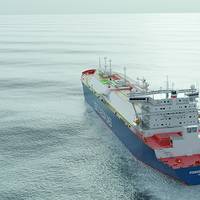
American Bureau of Shipping (ABS) has released its latest report into the potential of advanced nuclear technology for maritime applications, concluding the technology installed on LNG carrier would enable faster transit speeds with zero-emission operations.ABS conducted a study of a small modular reactor on a standard liquefied natural gas (LNG) carrier.The transformational impact of a high-temperature, gas-cooled reactor (HTGR) on the design, operation and emissions of a 145…



